Executive Summary
Recycled concrete aggregate (RCA) and quarry crusher run compete for the same layers of a project — sub-base, fill, hardstands, haul roads — but they are not interchangeable in every application. RCA is produced by crushing and screening demolition concrete; its defining feature is adhered residual mortar, which lowers particle density and raises water absorption relative to virgin granite aggregate (McNeil and Kang, 2013; Silva, de Brito and Dhir, 2014). Well-produced RCA routinely meets sub-base and general-fill requirements and offers meaningful cost and carbon advantages; virgin crusher run remains the default where specifications demand it, particularly in structural and heavily loaded applications. The correct engineering position is neither enthusiasm nor prejudice: it is the test report. Suitability depends on the project specification, the source material, gradation, and the results of standard tests — sieve analysis, compaction, CBR and abrasion — read against the governing specification, commonly JKR's Standard Specification for Road Works in Malaysian practice (Jabatan Kerja Raya Malaysia, 2013).
1. The two materials
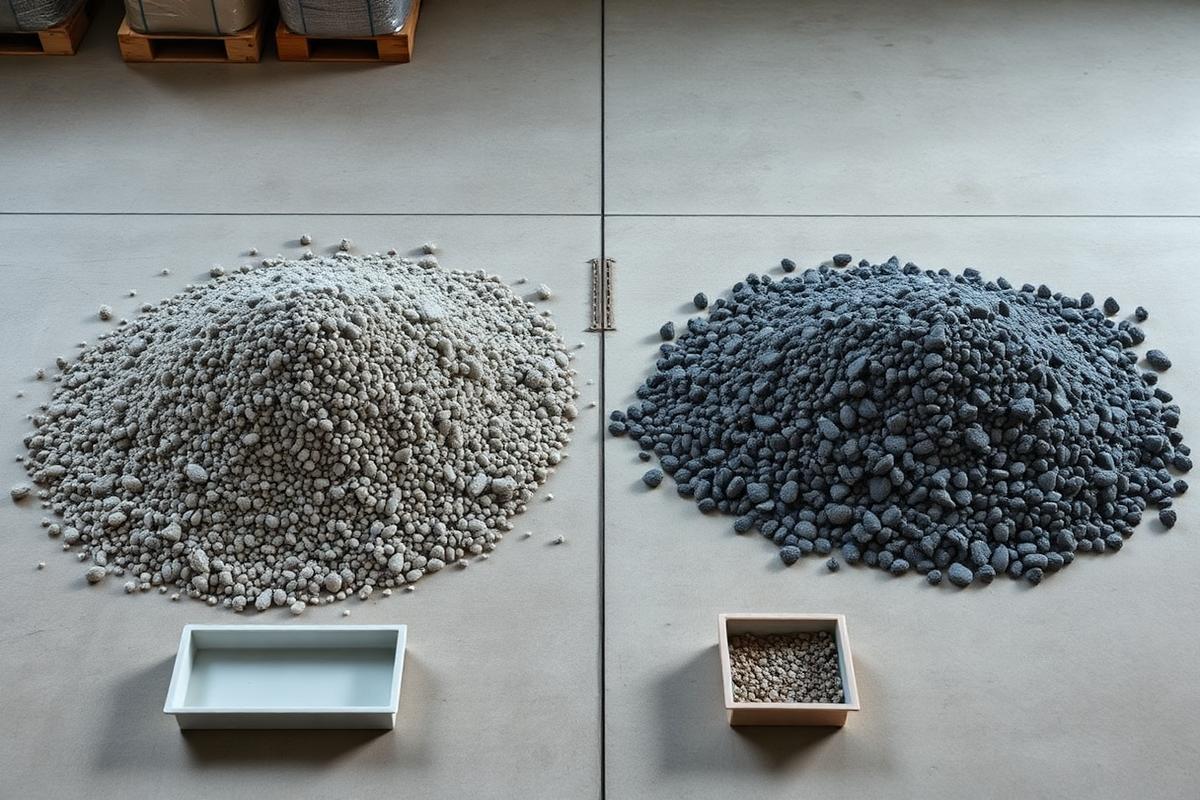
Quarry crusher run is freshly blasted rock — typically granite in the Klang Valley — crushed and screened to a continuously graded envelope from coarse particles down to fines. Angular, dense and consistent, it compacts into an interlocked matrix, which is why it is the default unbound granular material for road base and sub-base work.
Recycled concrete aggregate is demolition concrete processed through the same mechanical logic: crushing, screening and contaminant removal (rebar extracted magnetically; timber, plastics and gypsum picked out). The output is graded to equivalent envelopes — crusher-run equivalent, single-sized 20mm or 40mm, and hardcore. The difference is the feedstock's history: each particle is natural stone plus a fraction of adhered mortar.
2. What the adhered mortar changes
The engineering differences between RCA and virgin aggregate flow almost entirely from that mortar fraction (Silva, de Brito and Dhir, 2014):
| Property | Recycled aggregate (typical tendency) | Quarry crusher run | Notes |
|---|---|---|---|
| Particle density | Lower | Higher | Mortar is lighter than granite |
| Water absorption | Higher | Lower | Mortar is porous; affects moisture management at compaction |
| LA abrasion loss | Higher | Lower | Mortar abrades more readily than parent rock |
| Gradation | Controlled by production | Controlled by production | Both are process outcomes — demand the sieve certificate for either |
| CBR (compacted) | Frequently meets sub-base requirements; verify per batch | Reliably high | RCA can exhibit self-cementing behaviour from unhydrated cement, which may improve bearing over time (McNeil and Kang, 2013) |
| Drainage | Adequate in graded products | Good | Fines content governs both |
| Consistency | Depends on feedstock control | Depends on quarry face | Producer discipline is the real variable |
Engineering note: none of these tendencies is a verdict. They are reasons to test. A well-controlled RCA batch can outperform a poorly controlled quarry product; the certificate, not the origin, is the specification document.
3. Where each belongs
| Application | RCA | Quarry crusher run | Comment |
|---|---|---|---|
| Sub-base | ✔ commonly suitable, subject to spec and testing | ✔ | The primary RCA market internationally |
| Road base (heavily loaded) | Case-by-case against governing spec | ✔ default | Verify abrasion and CBR against JKR requirements (Jabatan Kerja Raya Malaysia, 2013) |
| General / platform fill | ✔ | ✔ | RCA's strongest cost case |
| Haul roads, hardstands | ✔ | ✔ | Low-risk entry application |
| Pipe bedding | Generally single-sized virgin preferred | ✔ | Follow the utility owner's spec |
| Drainage layers | Graded RCA acceptable where spec allows | ✔ | Watch fines |
| New concrete production | Partial replacement only, with testing, where the concrete spec permits | ✔ | International practice limits RCA fractions by exposure class (Silva, de Brito and Dhir, 2014) |
| Landscape works | ✔ | ✔ | Either |
4. Environmental and cost considerations
Every tonne of RCA used displaces a tonne of blasted, hauled quarry rock and diverts a tonne of demolition material from disposal — a double reduction in extraction pressure and landfill demand that feeds directly into project recycled-content reporting and green-building credit calculations. Recycled steel and aggregate loops are established levers in construction-sector circularity precisely because the material performs while the footprint falls. On cost, RCA generally prices below virgin equivalents because its feedstock is a recovered stream rather than a blasted one; the differential moves with market conditions, so current pricing should be requested rather than assumed. No figures are quoted here deliberately: both quarry and recycled prices are quotation-day facts, not article facts.
5. How to specify (and buy) intelligently
- Name the layer, not the loyalty. Specify performance: gradation envelope, CBR minimum, abrasion limit, fines content — then let materials qualify by test.
- Demand batch documentation. Sieve analysis per production batch; CBR on request for load-bearing use; source declaration for RCA (structural demolition concrete vs mixed rubble matters).
- Manage moisture. RCA's higher absorption means compaction moisture control deserves attention; brief the compaction crew.
- Trial load first. Ten tonnes and a test strip answer more questions than ten meetings.
- Check the governing spec. Where JKR or the project engineer's specification applies, acceptance is theirs to grant — supply them the documentation early (Jabatan Kerja Raya Malaysia, 2013).
⚠ Warning: reject any recycled aggregate offered without test documentation. The material may be sound; the vendor's process is not.
Material selection checklist
☐ Governing specification identified ☐ Required gradation envelope stated ☐ CBR / abrasion limits confirmed ☐ Batch sieve certificate obtained ☐ Source material declared ☐ Trial load and test strip agreed ☐ Compaction moisture plan set
Frequently asked questions
Is recycled aggregate legal for public works? Acceptance depends on the applicable specification and the engineer's approval for the layer concerned. Provide test documentation; approval is application-specific.
Does RCA get stronger over time? Compacted RCA can exhibit self-cementing behaviour attributable to unhydrated cement in the mortar fraction, documented in the literature (McNeil and Kang, 2013). Treat it as a bonus, not a design value.
Can RCA go into structural concrete? Only as a tested partial replacement where the concrete specification permits, consistent with international guidance limiting replacement by exposure class (Silva, de Brito and Dhir, 2014).
References
Jabatan Kerja Raya Malaysia (2013) Standard Specification for Road Works, Section 4: Flexible Pavement (JKR/SPJ/2013-S4). Kuala Lumpur: Jabatan Kerja Raya. McNeil, K. and Kang, T.H.-K. (2013) 'Recycled concrete aggregates: a review', International Journal of Concrete Structures and Materials, 7(1), pp. 61–69. Silva, R.V., de Brito, J. and Dhir, R.K. (2014) 'Properties and composition of recycled aggregates from construction and demolition waste suitable for concrete production', Construction and Building Materials, 65, pp. 201–217.
Related articles
What Construction Waste Disposal Actually Costs in the Klang Valley · Building a Waste Dataset That Stands Up to Assurance · Who Is Legally Responsible for Construction Waste?
Evaluating materials for a project? Mahawijaya supplies graded recycled aggregate with batch sieve analysis and CBR documentation on request, produced at our Puchong facility and delivered across Selangor and Kuala Lumpur. Trial loads arranged. [Request Price & Stock] · [Request a Trial Load]
Disclaimer: This article provides general engineering information, not design advice. Material selection remains the responsibility of the project's designer against the governing specification and current test results.